Interactive Planning, Idealised Design, and Wardley Mapping

· 6 min read
Dave Hulbert
Builder and maintainer of Wardley Leadership Strategies

In our last post, we explored how Soft Systems Methodology can help us make sense of messy, contested situations. We saw how SSM allows us to negotiate a shared understanding of a problem space, creating a foundation for purposeful action. But how do we move from understanding the present to designing a better future?

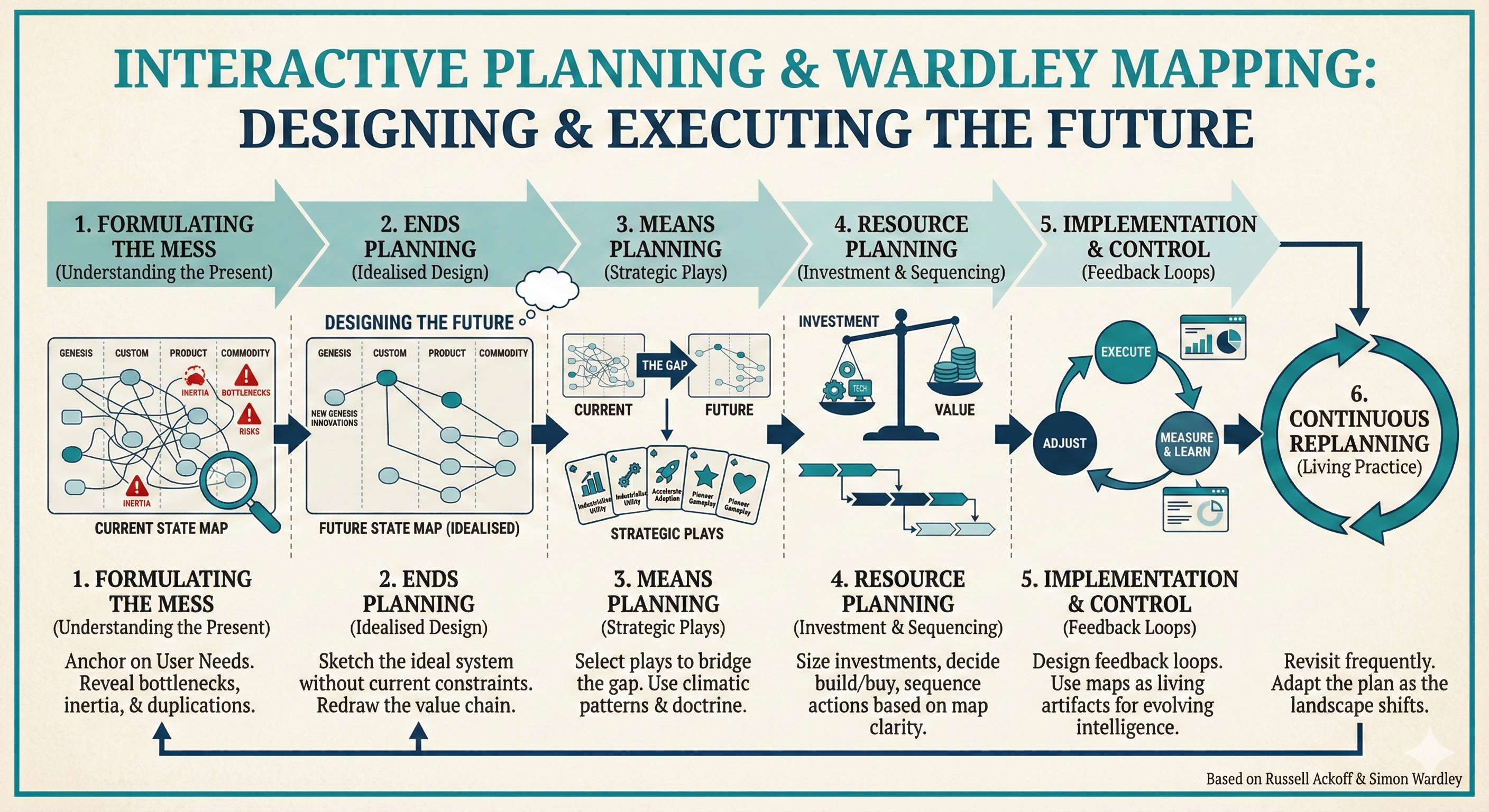
Russell Ackoff's interactive planning and Wardley Mapping both ask leaders to design the future, not just forecast it. Together, they give teams the narrative, visual, and strategic tools to make that future a reality. Idealised design sketches the destination, while maps expose the terrain we must cross and the moves that will get us there.

The Cybernetic Fate of Organisations

· 10 min read
Dave Hulbert
Builder and maintainer of Wardley Leadership Strategies

In our previous post, we explored how Panarchy and adaptive cycles help us understand the dynamics of change in complex systems. We saw how systems evolve through growth, conservation, release, and reorganisation. But how can leaders influence these cycles and guide their organisations toward a better future?

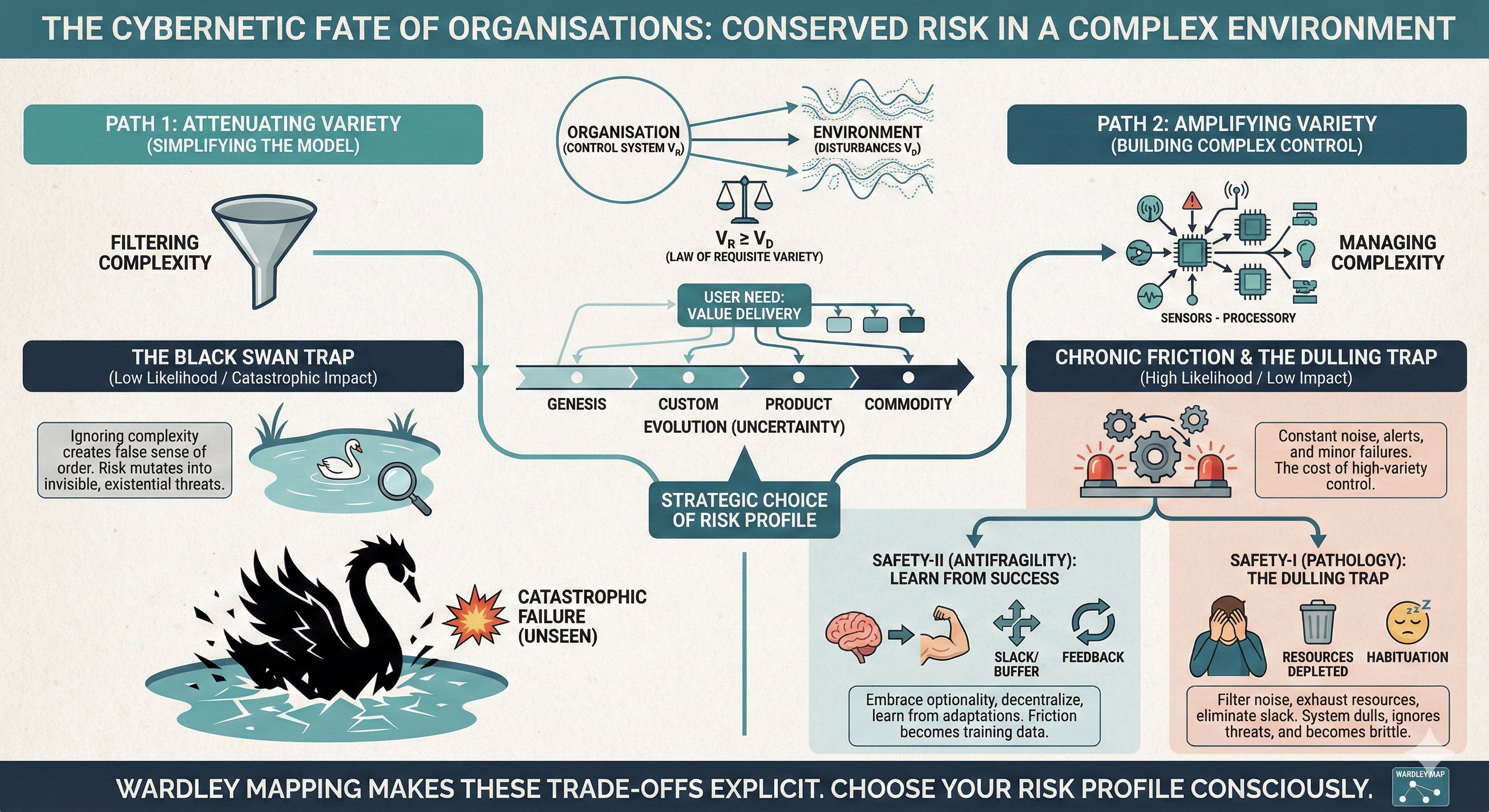
Many leaders see Wardley Mapping as a tool for visualising competition, not as a lens for understanding risk. This post bridges that gap. It shows how the cybernetic Law of Requisite Variety (LRV)—the idea that a control system must be as complex as the environment it’s trying to manage—and Wardley Mapping can reveal the hidden trade-offs organisations make when dealing with uncertainty.

Risk isn't eliminated; it's conserved and reshaped by the strategic choices an organisation makes about complexity. The LRV states that the variety (V) of your control system must be at least equal to the variety of disturbances from the environment: V_R ≥ V_D. 'Variety' is just a way of counting the number of different states a system can be in. For an organisation in a volatile market, the real decision isn't about reducing risk, but about transforming the risk it can't get rid of. This transformation depends on a choice of risk profile, which boils down to a trade-off between the likelihood (L) and the impact (I) of failure. This leads to two cybernetic traps: the Black Swan Trap, where hiding from complexity leads to rare, catastrophic shocks, and the Dulling Trap, a result of amplifying complexity in a pathological way.

Double-Loop Learning Keeps Wardley Maps Honest

· 5 min read
Dave Hulbert
Builder and maintainer of Wardley Leadership Strategies

In our last post, we explored the cybernetic fate of organisations and the difficult choices they face when dealing with complexity. We saw how important it is to match the complexity of the environment with the complexity of the organisation's response. But how can we be sure that our understanding of the environment is accurate and that our responses are the right ones?

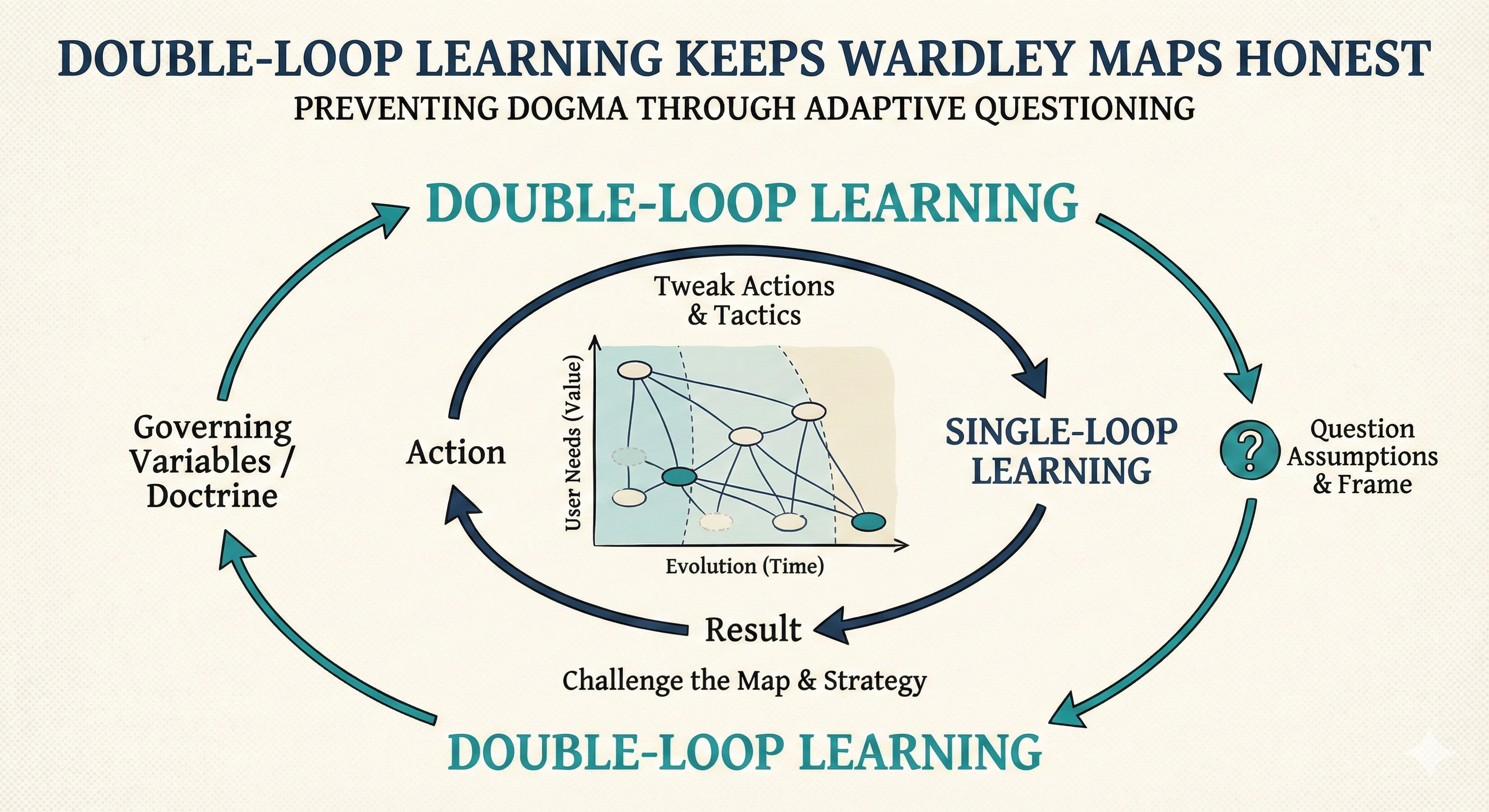
Wardley Maps can fool experienced teams into mistaking the map for the territory. When the landscape is drawn clearly, leaders can get caught up in making small tweaks instead of questioning the entire frame. This is where Double-loop learning—a concept from Chris Argyris and Donald Schön about questioning our underlying assumptions—brings back a dose of humility. It forces you to ask not only, "Did we place the components correctly?" but also, "Are we even mapping the right thing?"

Soft Systems Methodology Meets Wardley Mapping

· 9 min read
Dave Hulbert
Builder and maintainer of Wardley Leadership Strategies

In our last post, we explored how double-loop learning keeps Wardley Maps honest by forcing us to question the assumptions and frames that underpin our maps. But what happens when a problem is so messy and contested that we can't even agree on a starting point for the map?

Pairing Soft Systems Methodology (SSM)—Peter Checkland’s approach for exploring messy situations through multiple worldviews—with Wardley Mapping gives leaders a disciplined way to explore these situations, negotiate a shared worldview, and only then convert that clarity into the structure of a map. SSM makes space for conflicting narratives and hidden assumptions, while Wardley Maps translate an agreed purpose into visible components, evolution, and strategic plays. Together, they form a loop: learn the situation, model a purposeful change, map what needs to exist, and then test your strategy against reality.

Rugged Landscapes and Wardley Maps

· 5 min read
Dave Hulbert
Builder and maintainer of Wardley Leadership Strategies

In the previous post, we explored how the Viable System Model provides a blueprint for designing adaptive organisations. We saw how the VSM helps us balance autonomy and control, creating a system that can sense and respond to a complex environment. But what makes an environment complex in the first place?

Kauffman's NK model explains why the left side of a Wardley Map feels chaotic, and it shows how leaders can deliberately smooth that landscape without losing strategic edge. When N components are tightly coupled (high K), every move can collapse into a local optimum; modularity, doctrine, and adaptive gameplay are the tools for reshaping the terrain.

Panarchy, Adaptive Cycles, and Wardley Climatic Patterns

· 5 min read
Dave Hulbert
Builder and maintainer of Wardley Leadership Strategies

In our last post, we explored how the NK model helps us understand the rugged landscapes of innovation and the challenges of navigating complex, interconnected systems. But how do these landscapes change over time, and how can we anticipate and adapt to the inevitable cycles of growth, collapse, and renewal?

Wardley Mapping tells us which way the river of evolution flows; Panarchy—the ecological model of nested adaptive cycles—shows how each boat gains, loses, and renews its resilience along the way. Pairing the two reveals why some organisations ride climatic currents toward new value while others sink under their own rigidity.

Cybernetic AI Leadership with the Viable System Model

· 6 min read
Dave Hulbert
Builder and maintainer of Wardley Leadership Strategies

In the last post, we explored how AI can accelerate the discovery of user needs, helping us to stay grounded in the lived experience of our customers. But as we get better at sensing and responding to these needs, we face a new challenge: how do we design an organisation that can adapt and evolve at the speed of AI?

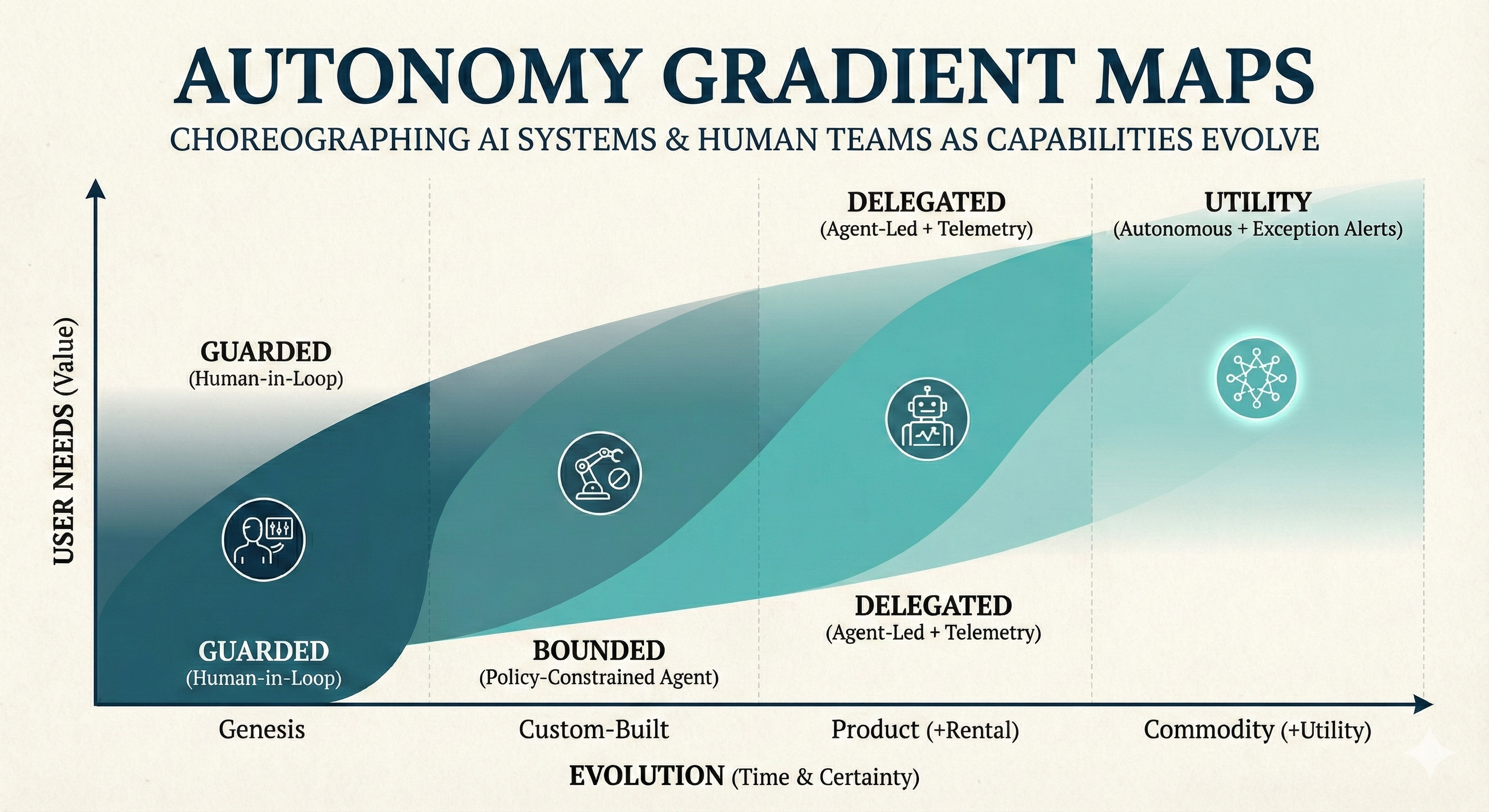
Stafford Beer’s Viable System Model (VSM)—a cybernetic blueprint for balancing autonomy and control—offers leaders a way to orchestrate humans and AI agents without drowning in complexity. The VSM breaks any adaptive organisation into five interacting systems that sense, coordinate, direct, and reinvent themselves. While Wardley Maps reveal evolutionary position, the VSM explains how to keep each component both autonomous and aligned. Embedding the model inside AI-era governance exposes where automation should amplify judgement—and where humans must remain the damping function.

AI-Accelerated User Needs Leadership

· 5 min read
Dave Hulbert
Builder and maintainer of Wardley Leadership Strategies

In our previous post, we explored how to use LLM-driven competitor simulations to anticipate and prepare for the moves of our rivals. But a purely external focus is not enough. To create lasting value, we must also have a deep and evolving understanding of our users.

Leaders default to visible requirements, yet competitive advantage emerges when you stretch beyond the backlog to hypothesise the needs users can’t articulate. Wardley Mapping, and its user needs-focused cousin, remind us that "what people ask for" is only the top layer. AI now gives us leverage to work the deeper layers without guesswork.

LLM-Driven Competitor Simulations

· 6 min read
Dave Hulbert
Builder and maintainer of Wardley Leadership Strategies

In the last post, we explored how background AI can drive relentless improvement, ensuring that the organisation is always operating from a position of strength. But a strong internal foundation is only half the battle. How do we anticipate and prepare for the moves of our competitors in a rapidly evolving, AI-driven landscape?

Competitors rarely share their Wardley Maps, but language models can synthesize likely alternatives so you can prepare without guessing blindly. Treating large language models as hypothesis engines lets leaders surface combinations of doctrine, climatic patterns, and intent that rival teams could pursue. The trick is to design the prompts like Monte Carlo simulations—generate many maps, prune bias, and focus your attention on the handful of plays that would genuinely disrupt your landscape.

Background AI for Relentless Improvement

· 6 min read
Dave Hulbert
Builder and maintainer of Wardley Leadership Strategies

In our last post, we discussed the importance of positioning and readiness in the age of AI. We saw how a clear understanding of the landscape and a portfolio of prepared plays can create a decisive advantage. But how do we ensure that the organisation is always ready to execute, without drowning in technical debt and operational friction?

The sharpest organisations let AI work in the background, continually raising internal quality while humans focus on intent and imagination. Background agents monitor maps, refactor components, and tune processes so that Wardley plays fire from a better baseline every week. Rather than heroic transformation programmes, leaders deploy ambient intelligence that nudges the system toward higher maturity as a matter of routine. It is the maintenance layer that keeps autonomous strategy execution trustworthy and ensures the diffused agency described in anti-fragile chaos engineering drills does not descend into entropy.